
Promotion of Active Learning
Accredited and approved continuing education for FNOCC certification emphasises active learning: methods where participants practise, discuss, solve problems, or apply skills, rather than only listening or watching.
Why Active Learning Matters
Research on how people retain information (often illustrated as a learning pyramid) shows that retention rises when learners move from passive intake to active use:
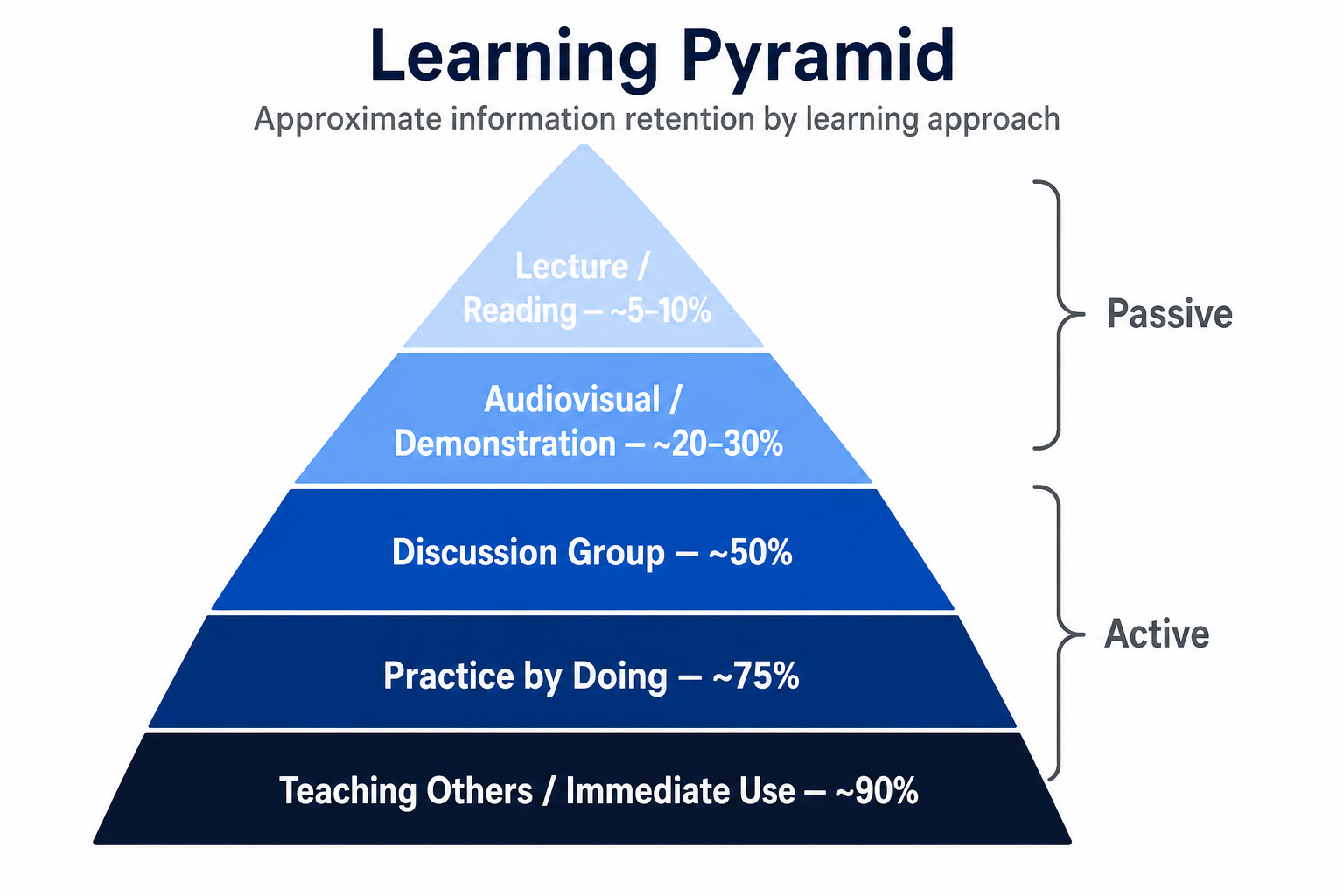
| Learning approach | Typical retention (approximate) | Passive or active |
|---|---|---|
| Lecture / reading | Lower | Passive |
| Audiovisual / demonstration | Moderate | Mostly passive |
| Discussion group | Higher | Active |
| Practice by doing | Higher | Active |
| Teaching others / immediate use | Highest | Active |
Exact percentages vary by study and context. The practical takeaway for operators is clear: courses that ask you to apply skills stick better than courses that only present information.
Active Versus Passive Learning
Passive learning includes lectures, reading slides, watching videos without interaction, and similar one-way delivery.
Active learning includes hands-on practice, scenario exercises, troubleshooting drills, group problem-solving, teach-backs, simulations, and assessments that require application.
FNOCC-aligned CEU courses are expected to include a minimum of 20% active learning so operators can practise skills that support safe, reliable water and wastewater system operations.
For Course Providers and Operators
- Design sessions so a meaningful share of time is spent doing, discussing, or applying content.
- Document active-learning components when seeking CEU recognition.
- Operators should prefer courses that include practice, not only presentation.
For full CEU rules, see the CEU Requirements summary and the First Nations Operator Certification Standards.